Maryland's Largest School District
 MONTGOMERY COUNTY PUBLIC SCHOOLS
MONTGOMERY COUNTY PUBLIC SCHOOLS
MONTGOMERY COUNTY PUBLIC SCHOOLS
FUTURE READY
All students will graduate ready to thrive in a changing world—with the knowledge, skills, and confidence necessary to lead, adapt, and make a positive impact in their communities and beyond.
TO UNLEASH POTENTIAL
All students will receive a solid academic foundation, grounded in strong critical thinking skills, with opportunities to enhance and enrich their learning. All students will develop resilience, be adaptable, and have a lifelong passion for learning. All students will become effective communicators and collaborators predicated on meaningful relationships. All students will make a positive impact in their community and be ready for success in their personal and professional life.
#MCPSFUTUREREADY
Dear MCPS Community,
Each school year marks a new chapter in our shared journey to prepare students for their future. The 2024–2025 school year was one of transition, focus, and purpose. It was a year in which we faced some of the hard truths about where we needed to grow as a school system, even as we celebrated the extraordinary strengths that make Montgomery County Public Schools a great place to learn and work.
The year also marked the beginning of new leadership and a renewed focus on listening to our community. Together, we engaged students, staff, families, and community partners across Montgomery County to understand their hopes and concerns. Through dozens of conversations, listening sessions, and school visits, we charted a course forward—one shaped by the voices of those we serve.
The proposed operating budget in December of 2024 reflected this listening. It began to address critical needs in areas such as safety and security, staffing, academic excellence, and facilities conditions. We also communicated our commitment to ensuring that every student—no matter their background, zip code, or learning style—had the support they needed to thrive.
While the year required honest reflection, it also offered countless moments to celebrate. Our students achieved at high levels, led with purpose, and made meaningful contributions to their schools and communities. Our educators and staff inspired excellence, created welcoming environments, and modeled the resilience and adaptability we strive to instill in every learner. But we also shared that more needed to be done because not every student had or continues to have an equitable experience, and to remedy those concerns, we’ve begun some important initiatives in the 2025-2026 school year, namely the boundary studies, secondary programs analysis, and proposed regions model.
Our core values mean the commitment to our students remains clear:
This Annual Report reflects the work and progress of a school district proud of its accomplishments and committed to continuous improvement. Each year brings opportunities to learn and grow so that MCPS remains a place where students and staff thrive.
With gratitude and determination,

Julie Yang
President, Board of Education

Thomas W. Taylor, Ed.D., M.B.A.
Superintendent of Schools
Across 507 square miles Montgomery County is the most populous county in the state of Maryland, with more than 1 million residents.
Montgomery County Public Schools serves more than 160,000 students. Our mission is straightforward: prepare all students to thrive in their future with the knowledge, skills, and confidence to lead, adapt, and make a positive impact in their communities.
As Maryland's largest school district, we're also one of the most diverse. Our students speak 170 languages. Our staff includes more than 25,000 employees who are all essential to keeping our schools running and our students supported.
includes 219 teachers newly certified in December 2024
a prestigious award recognizing proficiency in 2 or more languages
includes 2 schools newly named in 2024-2025 school year.

2024-2025 School Year

137 Elementary | 40 Middle
25 High | 5 Special
2 Early Childhood Centers
1 Technology High School
1 Alternative Education Program

Full-time: 18,767 / Part-Time: 7,130

other than English

Total Number Earned
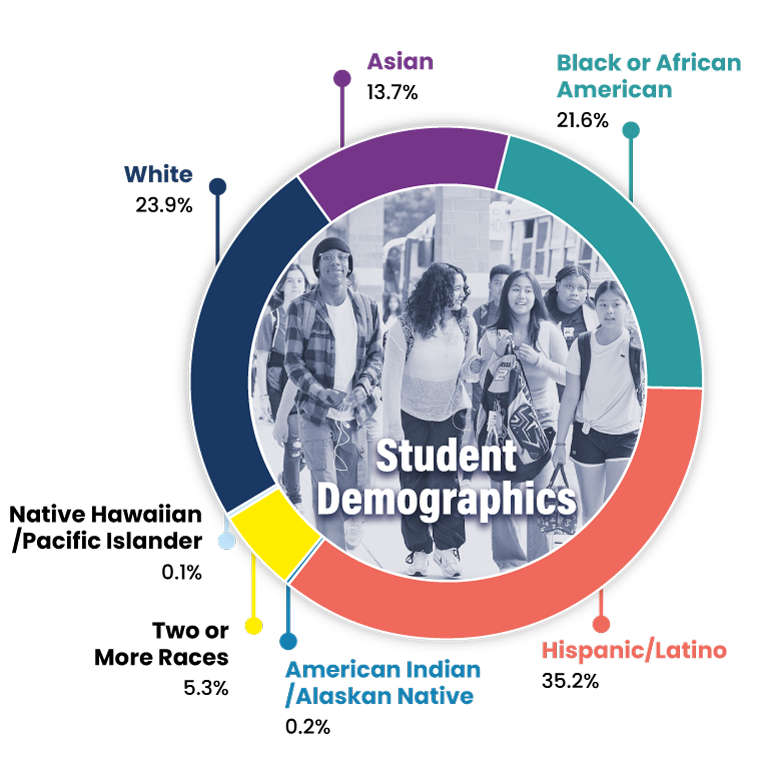
Hispanic/Latino: 35.2%
White: 23.9%
Black or African American: 21.6%
Asian: 13.7%
American Indian or Alaskan Native: 0.1%
Two or More Races: 5.3%
Native Hawaiian/Pacific Islander: 0.1%

White: 66.6%
Black or African American: 14.4%
Hispanic/Latino: 9.9%
Asian: 7.3%
American Indian or Alaskan Native: ≤5%
Two or More Races: ≤5%
Native Hawaiian/Pacific Islander: ≤5%
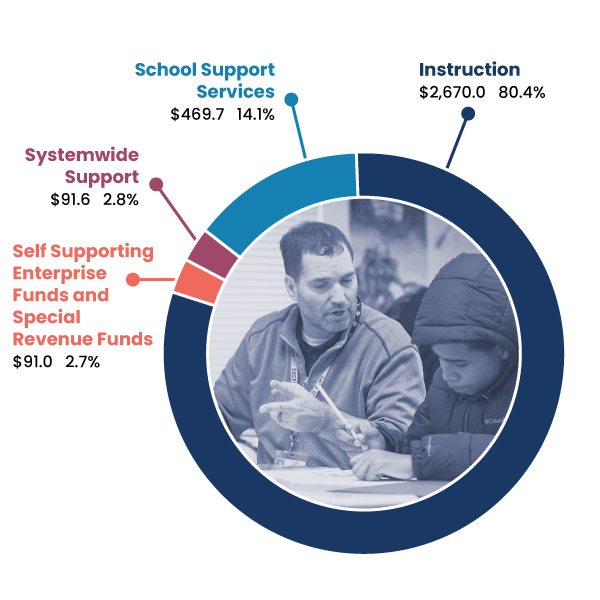
The FY 2025 Operating Budget approved by the County Council in May 2024 and adopted by the Board in June 2024, was $30.6 million less than the Board’s budget request. However, the FY 2025 Operating Budget is $147.3 million more than FY 2024.
Where the money goes
Total Expenditures = $3,322,306,526
(Dollars in Millions on Chart)
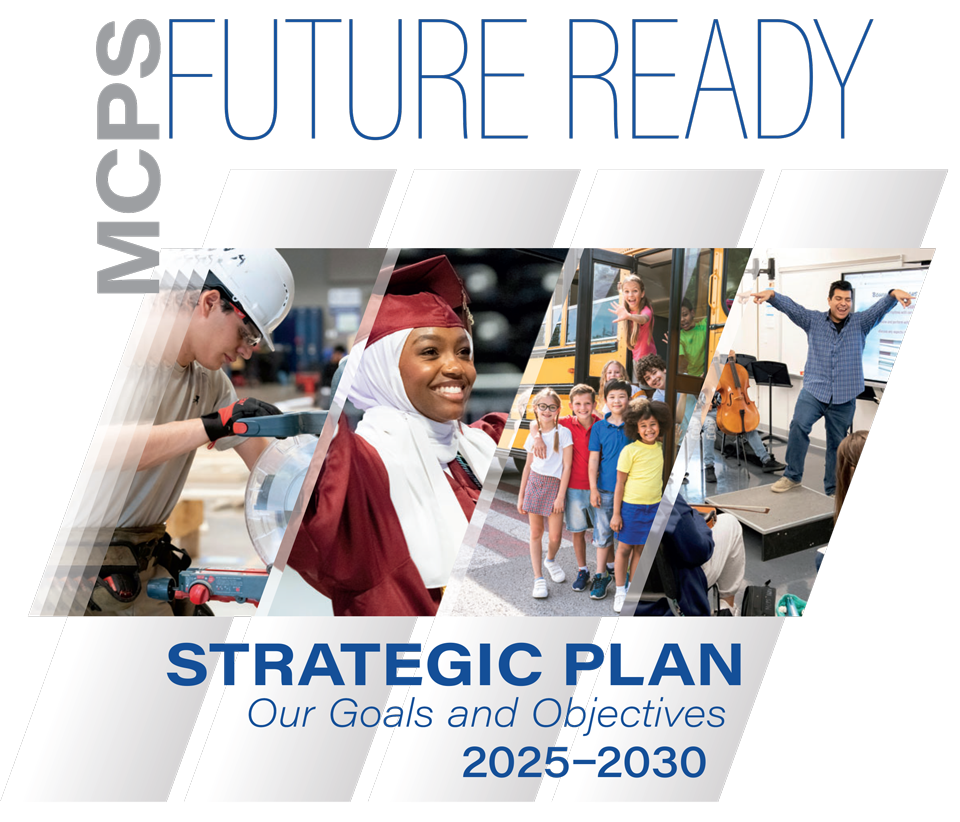
In 2024–2025, MCPS began developing a new multi-year strategic plan to guide our work in the years ahead. The plan focuses on the foundational work of improved student outcomes and stronger operational performance. It introduces aligned systemwide goals and clear scorecards to track progress, drive accountability, and ensure consistent focus across every school and office.
 GOAL 1:
 GOAL 2:
 GOAL 3:
 GOAL 4:
By 2030, every student will be able to build a personal portfolio that shows their growth and readiness for the future as guided by the MCPS Future Ready Framework. Students and families will receive clear information to help them understand their child’s learning and celebrate achievements.
Knowledge, skills, and dispositions that every graduate should have and will develop in their time as a student in Montgomery County Public Schools.
MCPS graduates engage in inquiry, experimentation, analysis, problem solving, and informed decision making.
MCPS graduates exchange thoughts and ideas effectively using oral, written, and nonverbal communication skills across different contexts.
MCPS graduates demonstrate empathy, flexibility, and the ability to compromise and self-reflect while working together to achieve common goals.
MCPS graduates develop innovative ideas and original work using all available resources around them.
MCPS graduates are equity-minded, compassionate, and caring; they make a positive impact in our community through leadership, service, empathy, respect, and integrity.
MCPS graduates are aware of and attend to their physical, emotional, and mental well-being.
The 2024–2025 school year served as the baseline year for the new strategic plan, and each goal now includes a scorecard—with baseline data—that is presented in this annual report.
The specific actions and timelines for the Strategic Plan will be finalized during the 2025–2026 school year.
The 2024–2025 school year served as the baseline year for the new strategic plan, and each goal now includes a scorecard—with baseline data—that is presented in this annual report.
| Objective | Performance Metric(s) | Measures | 2024-2025 Baseline |
2025-2026 | 2026-2027 | 2027-2028 | 2028-2029 | 2029-2030 | Reporting Frequency |
|||||
|---|---|---|---|---|---|---|---|---|---|---|---|---|---|---|
| Target | Actual | Target | Actual | Target | Actual | Target | Actual | Target | Actual | |||||
| OBJECTIVE 1 — MCPS will have the highest academic performance in Maryland, as measured by the Maryland School Report Card. | % of schools with star rating of 4 or higher | Maryland School Report Card | 53.5% | Annual | ||||||||||
| Ranking of MCPS among Maryland districts based on composite score and star ratings | Maryland School Report Card | 9th based on percent of 4 & 5 stars | Annual | |||||||||||
| OBJECTIVE 2 — All students will meet proficiency benchmarks and grow in literacy, Grades Pre-K–11. | % of students scoring proficient or above on state English Language Arts/Literacy (ELA/L) assessments | MCAP/ALT-MCAP ELA/L ELA/10 |
57% | Annual | ||||||||||
| % of students meeting or exceeding gradelevel reading expectations on formative literacy assessments | MAP Reading DIBELS |
DIBELS: 72.9% MAP-R Grades 3-8: 52.2% |
Biannual Triannual |
|||||||||||
| % of students exceeding growth expectations | DIBELS MAP Reading |
In Development | Triannual | |||||||||||
| % of Multilingual learners exiting EL status | ACCESS/Alt-ACCESS | 9.9% | Annual | |||||||||||
| % of Multilingual learners meeting annual growth target or minimum growth expectation | ACCESS/Alt-ACCESS | 37% | Annual | |||||||||||
| OBJECTIVE 3 — All students will demonstrate reading proficiency by the end of Grade 1. [BP: Pillar 3] | % of Grade 1 students meeting or exceeding benchmarks on district-wide early literacy assessments | DIBELS | 74.7% | Annual | ||||||||||
| % of Kindergarten and Grade 1 students identified as on-track for reading proficiency based on mid-year and end-of-year benchmarks | DIBELS | Mid: 60.7% End: 74.2% |
Biannual | |||||||||||
| % of students receiving targeted reading interventions in K–1 who demonstrate catchup growth | DIBELS Interventions |
47.2% | Biannual | |||||||||||
| OBJECTIVE 4 — All students will meet proficiency benchmarks and grow in mathematics, grades Pre-K–11. | % of students scoring proficient or above on state math assessments. | MCAP Mathematics | 35.7% | Annual | ||||||||||
| % of students exceeding growth expectations | MAP Mathematics | 48% | Biannual | |||||||||||
| % of students meeting grade-level expectations on district-wide math assessments | Required District Assessments |
Overall: 52.4% Elementary: 58.10% Middle: 56.70% High: 38.90% |
Quarterly | |||||||||||
| OBJECTIVE 5 — All high school students seeking a diploma will demonstrate success in Algebra 2 prior to graduation. | % of students who complete Algebra 2 with a grade of C or higher by Grade 11. | Grades | 73.9% | Annual | ||||||||||
| OBJECTIVE 6 — MCPS will close performance gaps between reporting categories, improving performance for all students; primary focus areas include students with disabilities, economically disadvantaged students, Multilingual Learners, Hispanic/Latino students, and Black or African American students. | Percentage-point gap in proficiency rates (ELA/L and math) between each reporting group and the target. | Maryland School Report Card: Equity |
In Development | Annual | ||||||||||
| % of schools reducing gaps in performance between reporting groups year over year | Maryland School Report Card: Equity |
In Development | Annual | |||||||||||
| OBJECTIVE 7 — MCPS will provide programmatic and discrete opportunities for all students to demonstrate innovation and enrichment to enhance learning experiences. | % of students enrolled in advanced, enriched, or accelerated courses and programming (e.g., honors, AP, IB, dual enrollment, centers for enriched studies) disaggregated by reporting groups | Course Enrollment | 61.2% | Biannual | ||||||||||
The Maryland Comprehensive Assessment Program (MCAP) provides information to educators, parents and the public on student progress towards proficiency on the Maryland state content standards. Through a strong assessment system, stakeholders gain an understanding of how schools are performing and where assistance can be directed to support student growth and achievement.
| 2025 Number | |
|---|---|
| All | 26175 |
| 2021 | 2022 | 2023 | 2024 | 2025 | |
|---|---|---|---|---|---|
| All MCPS | 68.1 | 72.4 | 73.5 | 76 | 76.6 |
| 2021 | 2022 | 2023 | 2024 | 2025 | |
|---|---|---|---|---|---|
| All MCPS | 87.0 | 82.5 | 68.8 | 63.1 | 62.7 |
The past year has been marked by significant achievements across the district:

91.8% on-time graduation rate for the Class of 2024—a 2.2 percentage point increase
*Class of 2025 graduation rate not yet available from MSDE
More than 93% of MCPS schools earned three or more stars on Maryland’s 2024 State Report Card—outpacing the statewide average by 10 points.

Class of 2025 earned $785 million in scholarships, opening doors to higher education.
Twelve additional schools earned the 2025 Maryland Green Schools designation, bringing our district total to 113 certified Green Schools.
This means 53% of all MCPS schools have achieved this status, surpassing the goal set by the Montgomery County Climate Action Plan.
8 schools ranked in Maryland's Top 25; all 25 schools ranked in the Top 100.
5 schools ranked in the National Top 500.

MCPS achieved significantly higher proficiency rates compared to the state average on the 2025 Maryland Comprehensive Assessment Program (MCAP) for all grades combined.
| Subject | District Proficiency (Proficient or Distinguished) | State Proficiency (Proficient or Distinguished) | Outperformance Margin |
|---|---|---|---|
| ELA All | 57.0% | 50.8% | +6.2 Percentage Points |
| Mathematics All | 35.7% | 26.5% | +9.2 Percentage Points |
Montgomery County Public Schools (MCPS) received several key recognitions throughout the 2024–2025 school year, spanning academic achievements, service learning, and staff excellence.
These honors underscore our district's commitment to setting the highest standards for student-centered excellence.
Our student body continues to demonstrate sustained academic excellence, securing prestigious national awards and record-breaking financial support for higher education.
MCPS continues to run the largest education-based interscholastic athletics program in Maryland, supporting over 29,000 student-athletes. This past year was one of record-setting success and high achievement, delivering a massive haul of team championships across all levels.

across all three seasons (fall: 9, winter: 6, spring: 4).
won by teams in the fall (25), winter (17), and spring (34).
a testament to systemwide competitive excellence.
A major focus of the year was embedding equity and inclusion into our initiatives, successfully broadening our offerings to engage hundreds of new student-athletes.
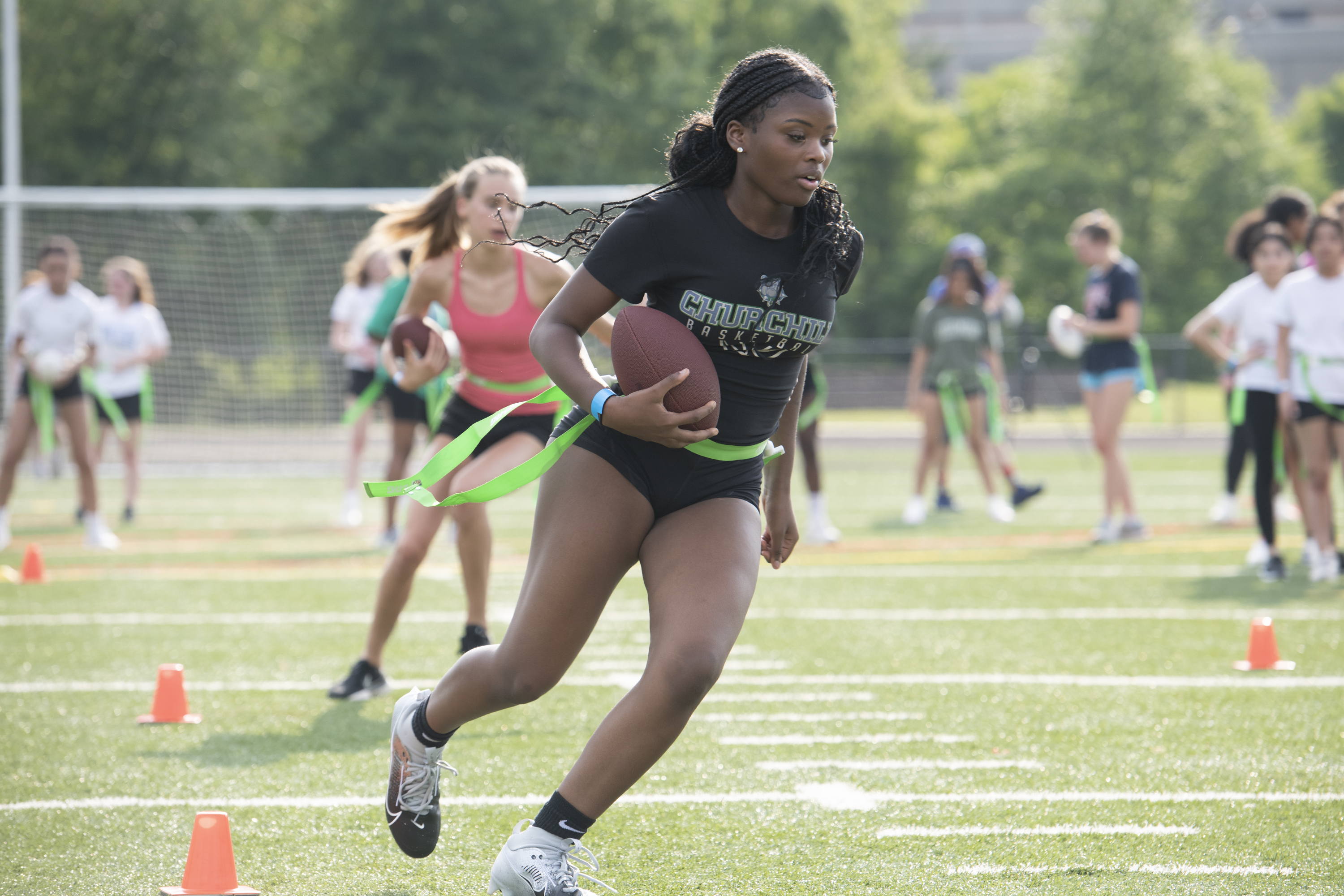
We introduced girls' flag football, which immediately added 630 new student-athletes to the program. This initiative helps broaden opportunities for female athletes in the district.
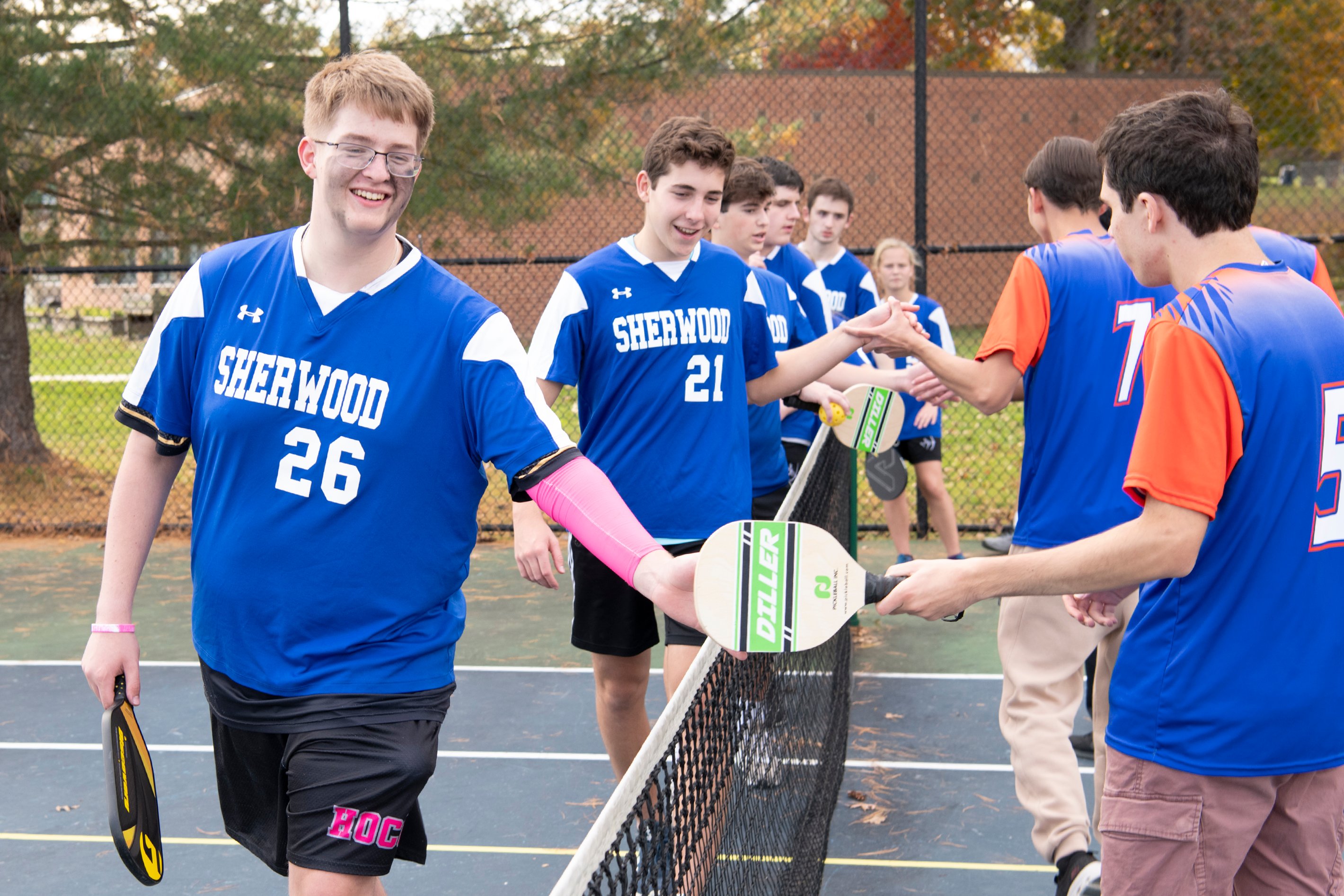
We became one of the first districts in the nation to introduce pickleball as a corollary varsity sport in all 25 high schools. The program successfully engaged an additional 393 participants.
 The Pickleball Diplomacy tour elevated student travel into true global partnership. Last year, 30 Montgomery County students—joined by Superintendent Dr. Thomas W. Taylor and Board of Education President Julie Yang—journeyed to China for a cultural and sports exchange across Shanghai, Shenzhen, and Beijing.
The impact transcended the court, generating dialogue that reached the highest levels of government. The experience sparked ongoing connections, including correspondence between MCPS Athletics Director Dr. Jeff Sullivan and Chinese President Xi Jinping emphasizing the crucial role of youth in U.S.–China relations.
This year, the exchange continued as Chinese students visited Maryland. Looking ahead, MCPS Athletics is expanding the initiative to include new sports and new countries, ensuring we continue to build friendships across the globe.
More at: pickleballdiplomacy.com.
We also made sure to recognize the coaches and leaders who make this success possible. Systemwide and school-based celebrations, including Coaches Appreciation Weeks, took place throughout the year. The Student-Athlete Leadership Council hosted an awards ceremony to honor 27 coaches of the year across the fall, winter, and spring seasons.

Jermaine Howell
Football, Wheaton High School
| Objective | Performance Metric(s) | Measures | 2024-2025 Baseline |
2025-2026 | 2026-2027 | 2027-2028 | 2028-2029 | 2029-2030 | Reporting Frequency |
|||||
|---|---|---|---|---|---|---|---|---|---|---|---|---|---|---|
| Target | Actual | Target | Actual | Target | Actual | Target | Actual | Target | Actual | |||||
| OBJECTIVE 1 — All high school students will have a plan to be employed, enlisted, and/or enrolled in a post-secondary learning institution upon graduation. | % of seniors completing key milestones aligned to their postsecondary plan | Postsecondary plan | In Development | Annual | ||||||||||
| % of seniors with a verified next step before graduation (e.g., military enlistment, signed job offer, college acceptance, etc.) | Postsecondary plan | In Development | Annual | |||||||||||
| % of seniors with a documented postsecondary plan in Naviance or district tracking system (enrolled, enlisted, or employed) | Postsecondary plan | In Development | Annual | |||||||||||
| % of graduating seniors with completed FAFSA or MSFAA applications | FAFSA/MSFAA | 61.2% | Annual | |||||||||||
| OBJECTIVE 2 — All high school students will have at least one real world learning experience, through internships, apprenticeships, field experiences, and/or authentic capstone experiences prior to graduation. [BP: Pillar 3] | % of high school students completing at least one real-world learning experience by graduation | Course/Module Enrollment | In Development | Annual | ||||||||||
| OBJECTIVE 3 — All middle school students will complete an individualized college and career readiness and exploration plan and will revisit and revise it with their school counselor annually. | % of middle school students with documented college and career plans reviewed at least once per year | CCR Plan | In Development | Annual | ||||||||||
| OBJECTIVE 4 — All elementary school students will develop awareness of the 16 career clusters and be provided with different opportunities to explore career fields within each cluster. | % of elementary students participating in at least one career exploration activity related to each of the 16 clusters | Course Enrollment/ Experience | In Development | Annual | ||||||||||
| OBJECTIVE 5 — All students will have access to and be successful in challenging, advanced learning opportunities that prepare them for high-quality postsecondary outcomes. | % of students meeting college- and careerreadiness benchmarks on SAT, ACT, or Accuplacer | CCR Benchmark | 45.97% | Annual | ||||||||||
| % of students taking SAT/ACT | SAT/ACT participation | 85.9% | Annual | |||||||||||
| OBJECTIVE 6 — All high school students will have access to and be successful in Post-College and Career Readiness Pathways (International Baccalaureate Diploma, AP program, Dual enrollment, Career and Technical Education program) to graduate with a diploma or certificate or program completion endorsement or at least one marketable credential or specialization. [BP: Pillar 3] | % of graduates who complete a CCR pathway or earn an endorsement/specialization (Seal of Biliteracy) | Diploma/Program Completion | 23.6% | Annual | ||||||||||
| % of graduates earning a CTE certification, industry-recognized credential, or college credit through dual enrollment | CCR | 27.1% | Annual | |||||||||||
| % of students meeting Maryland CCR standard | MD CCR Standard | 46% | Annual | |||||||||||
| % of students who graduate with an associate’s degree | Post-secondary plan | 2.5% | Annual | |||||||||||
| OBJECTIVE 7 — All high school students will successfully demonstrate financial literacy. | % of high school students who complete a financial literacy course or module prior to graduation | Course enrollment/module | 32.8% | Annual | ||||||||||
| OBJECTIVE 8 — All families will have an understanding of educational options and career pathways. | % of families reporting increased understanding of options and pathways on post-event surveys | Event Survey | In Development | Annual | ||||||||||
| Availability and usage rates of multilingual, accessible family resources (e.g., downloads/views of informational materials) | Remind usage ParentVue usage Language line | ParentVUE activation June 17, 2025: 91.2% of students have at least one Parent/caretaker with an active ParentVUE account | Annual | |||||||||||
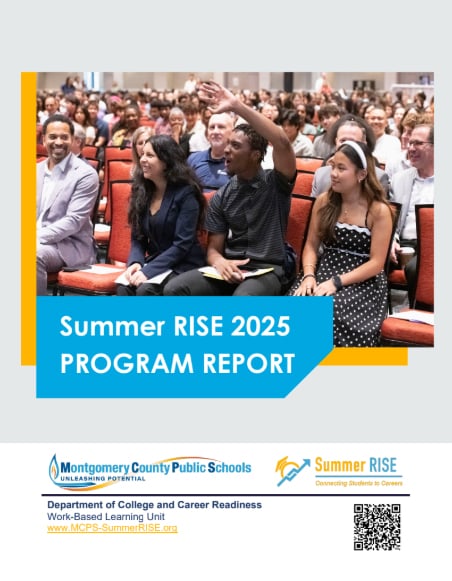 The Summer RISE (Reimagining an Innovative Student Experience) program provides rising high school juniors and seniors with a five-week, 50-hour career-based learning experience, bridging classroom knowledge with essential professional skills.
The 2025 program saw significant growth, involving 1,008 students (up from 905 in 2024). This hands-on program exposed students to 78 different career field options. Since its 2017 inception, Summer RISE has impacted over 5,536 students and 650 unique companies.
Student Impact and Partnerships
The program's success is rooted in strong community support from partners like WorkSource Montgomery, A Wider Circle (professional clothing), and Educational Systems Federal Credit Union (stipend processing).
For a full review of student success stories, employer profiles, and program impact, please scan the QR code to read the Summer RISE 2025 Program Report.
Dual Enrollment programs offer MCPS high school students a powerful head start on their academic future. The program experienced a significant 24% increase in participation, growing from 2,198 students in the 2023–2024 school year to 2,727 students in the 2024–2025 school year. Students from all 25 high schools and Thomas Edison High School of Technology can earn 30 or more college credits, while simultaneously meeting high school graduation requirements.
Highly motivated students can go further with dedicated Middle and Early College programs allowing them to earn 1 of 22 associate's degrees from Montgomery College before high school graduation. Our dual enrollment graduates are successfully transferring to top-tier universities, including Harvard, Howard University, MIT, Princeton, the University of Maryland, and other notable institutions.
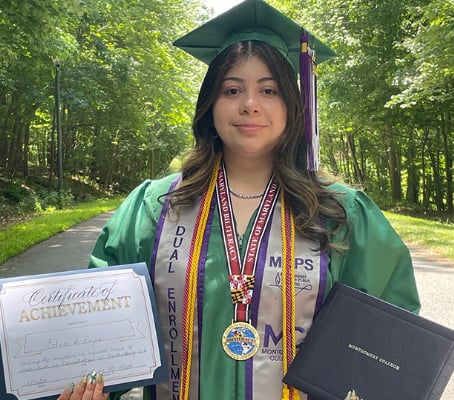 Recent graduate Edna Reyes exemplifies this success. Reyes earned her high school diploma from Damascus High School, completed the rigorous cosmetology program at Gaithersburg High School, and simultaneously earned an Associate's Degree in behavioral health from Montgomery College through Dual Enrollment. Her dedication was further recognized with the prestigious Maryland Seal of Biliteracy.
Career and Technical Education (CTE) is a focused sequence of courses that integrates academic knowledge with specific technical skills, preparing students for immediate career entry or further postsecondary study. This hands-on learning approach combines classroom instruction with real-world experience through project-based learning, apprenticeships, and internships.
CTE programs are available across all comprehensive high schools and at Thomas Edison High School of Technology. Offerings include 11 Clusters and 51 Programs of Study, comprising hundreds of courses, including AP, IB, and Dual Enrollment options. During the 2024–2025 school year, over 17,000 students participated in a CTE course, with 748 students earning at least one Industry Recognized Credential from 34 different certification areas. CTE pathways directly lead to high-wage, high-skill, and high-demand jobs, giving our students a powerful competitive advantage.
The Youth Apprenticeship Program outlines specific requirements for completion: students must complete a minimum of 450 work hours within a 14-month period, combined with industry-specific educational training and required certifications.
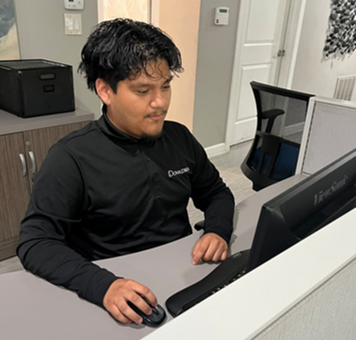 Chris Cabrera, a recent graduate of Springbrook High School, exemplifies the direct, real-world value of MCPS's Career and Technical Education (CTE) pathways. Having successfully completed the MCPS Youth Apprenticeship Program, Cabrera became the first graduate hired by his host firm, Donaldson, upon finishing high school.
Starting his apprenticeship in September 2023, Cabrera gained valuable, hands-on experience in the property management industry, mastering customer service and resident relations. He successfully completed the rigorous apprenticeship model, which requires students to work a minimum of 450 hours, while receiving related educational training and certifications.
The host firm stated: "This partnership has already proven to be rewarding and effective." Upon graduation, Cabrera's dedication and focus earned him a full-time position as a leasing consultant in Silver Spring—a direct result of the high-skill pipeline fostered by the CTE program. His achievement underscores how MCPS equips students with the professional skills and experience necessary to immediately enter high-demand, high-wage careers.
The Youth Apprenticeship Program outlines specific requirements for completion: students must complete a minimum of 450 work hours within a 14-month period, combined with industry-specific educational training and required certifications.
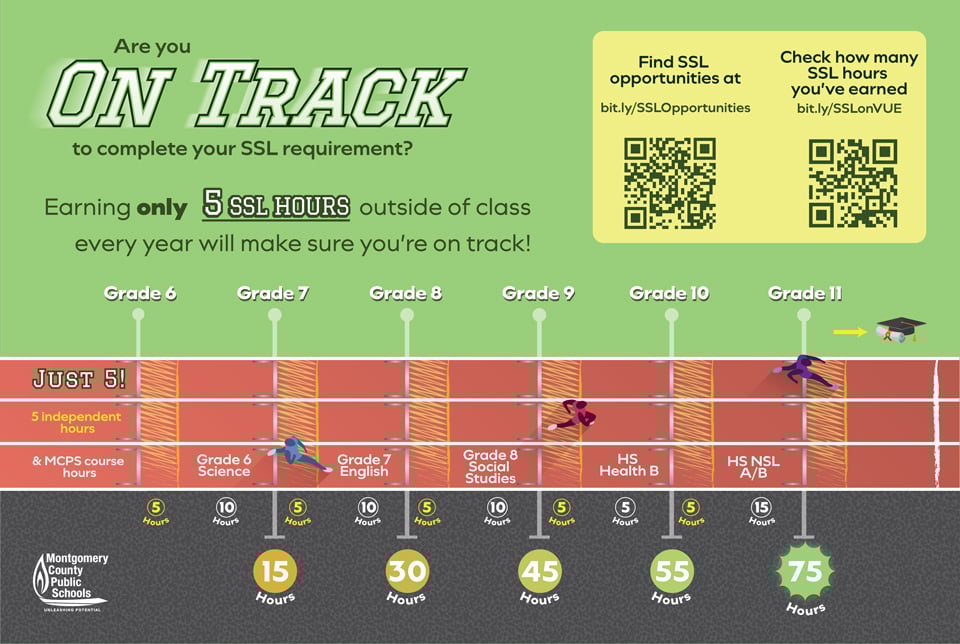
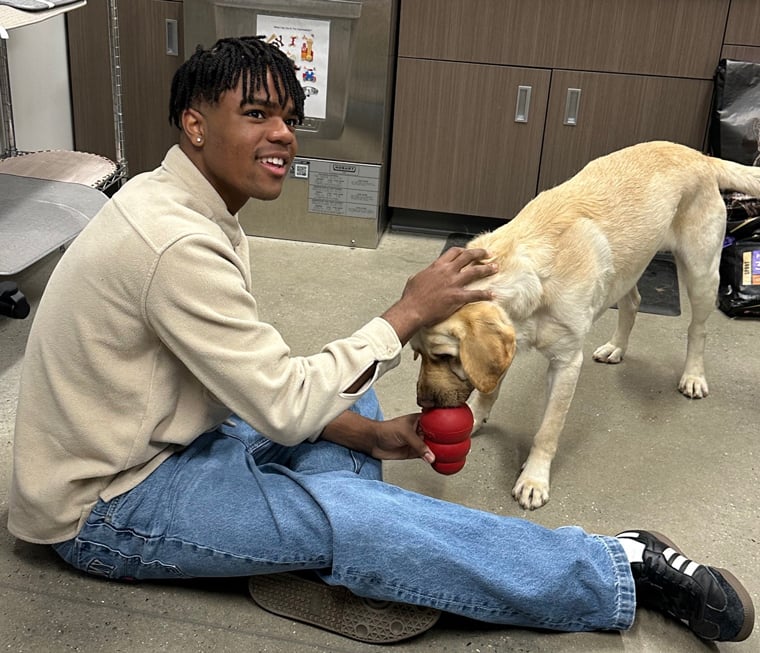 Student Service Learning is a cornerstone of the MCPS experience, requiring all students to earn 75 hours for graduation.
During the 2024–2025 school year, MCPS students achieved a phenomenal milestone by earning 2,570,155 total hours of community service. This dedication, often executed through partnerships with over 1,000 nonprofit organizations, addresses real-world challenges like food insecurity and environmental conservation. Beyond the community benefit, this mandatory service allows students to develop essential skills in leadership, communication, and problem-solving, while developing empathy, compassion, and self-awareness, enhancing their career readiness and personal wellness.
The program's comprehensive approach, spanning required course projects and signature campaigns like the MLK Week of Service, the Choose Respect Public Service Announcement Contest, and RespectFEST, earned MCPS the prestigious 2025 Gold Ribbon School District in Service-Learning award from Youth Service America. The program was one of only six districts nationally to receive this honor.
| Objective | Performance Metric(s) | Measures | 2024-2025 Baseline |
2025-2026 | 2026-2027 | 2027-2028 | 2028-2029 | 2029-2030 | Reporting Frequency |
|||||
|---|---|---|---|---|---|---|---|---|---|---|---|---|---|---|
| Target | Actual | Target | Actual | Target | Actual | Target | Actual | Target | Actual | |||||
| OBJECTIVE 1 — All students and staff are physically, mentally, and emotionally safe in their learning and work environments. | % of students and staff reporting positive experiences in their academic or work environment | Climate Survey MD School Survey |
MCPS District Survey: Students: 53.6 School-Staff: 72.7 Central Office: 73.7 MD School Survey: Student: 33.7% Staff: 47.7% |
Biannual Annual |
||||||||||
| OBJECTIVE 2 — Close gaps in how students, teachers, and families perceive the learning environment across different demographics and within schools. | % point gap in climate survey positive ratings between racial/ethnic groups or student groups | Climate Survey | Racial/ethnicity: 17.8 Service Group: 5.24 |
Biannual | ||||||||||
| % of schools with reduced disparity in survey responses across student, staff, and family demographics year over year | Climate Survey | % of school for students: 57.8 | Biannual | |||||||||||
| OBJECTIVE 3 — Reduce disproportionate suspension rates for Black or African American students and students receiving special education services. | % of in-school and out-of-school suspensions | Suspension Rates | In-School (Black or African American): 0.16% In-School (Special Education): 0.2% Out-of-School (Black or African American): 2.63% Out-of-School (Special Education): 2.78% |
Monthly | ||||||||||
| % of restorative approaches implemented | Critical Incidents | 4.7% out of 19,864 incidents | Monthly | |||||||||||
| % of disciplinary infractions | Disciplinary Infractions | Black or African American: 37.6% Special Education: 30.6% |
Monthly | |||||||||||
| OBJECTIVE 4 — Ensure that all families feel welcomed, supported, and valued. | % of families reporting positive experiences in their child’s academic environment | Climate Survey | 75.7% | Biannual | ||||||||||
| Family participation rate in school events, workshops, and conferences, disaggregated by reporting group | Event Survey/ Participation | 53 parent community coordinators (now family engagement specialists) reported 85,091 encounters through 802 outreach efforts. In collaboration with our colleagues in School Leadership & Improvement, we will develop a maxtrix to track three school level events, including participation and feedback from parents (ex. Back to School Night, Parent/Teacher Conferences, SIP Participation, etc.). In addition, we will also track sytemwide events (i.e., Parent Academy, Boundary/Program Analysis engagement, etc.). | Annual | |||||||||||
| OBJECTIVE 5 — Reduce hate-bias and bullying incidents. | # of documented bullying and hate-bias incidents reported annually, disaggregated by type and location | Hate-Bias/Bullying Incidents | Bullying = 1,017 Hate-bias = 253 |
Monthly | ||||||||||
| % of staff completing training on hate-bias prevention and inclusive practices | Training Participation | 2% | Annual | |||||||||||
| OBJECTIVE 6 — Ensure classroom space that aligns to programmatic needs, ensuring high-quality learning experiences. | % of schools meeting classroom-to-enrollment utilization targets aligned with educational specifications | Student-Teacher Ratio | In Development | Annual | ||||||||||
| # of capital improvement projects completed or in progress that address programmatic space needs | CIP Projects | 8 (Crown HS, Northwood HS, Poolesville HS, Woodward HS, SSIMS, Burtonsville ES, Greencastle ES, JoAnn Leleck ES @ Broad Acres) | Annual | |||||||||||
| OBJECTIVE 7 — Equitably distribute adequate resources to facilitate high-quality instruction. [BP: Pillar 4] | % of schools receiving differentiated funding and staffing support based on equity-based formulas (e.g., Title I, FARMS) | Funding allocation | 100% | Annual | ||||||||||
| Resource allocation index showing alignment of resources to student need (e.g., class size, support staff per student) | Allocation index | In Development | Annual | |||||||||||
| OBJECTIVE 8 — Ensure the continuous maintenance of all facilities (including schools, transportation and food services) that support a safe, functional, and ready environment for learning. | % of facility work orders completed within target response time | Work orders | In Development | Annual | ||||||||||
| % of facilities meeting or exceeding cleanliness, maintenance, and safety inspection standards | Inspections | In Development | Annual | |||||||||||
| Gap between work needed and work completed, and the time taken to complete request | Work orders vs. time requested | In Development | Annual | |||||||||||
| OBJECTIVE 9 — Transport students safely and on-time to school. | % of buses arriving on time | Bus arrivals | In Development | Annual | ||||||||||
| # of preventable bus accidents | Preventable accidents | 457 preventable accidents | Annual | |||||||||||
| % of transportation-related safety incidents reported | Safety incidents | % of preventable accidents which incurred costs over $3,000 (accident type: P8), Answer: (79/ 457) = 17% Citations – Stop Arm violations in DOT Answer: (49) |
Annual | |||||||||||
| OBJECTIVE 10 — Reduce carbon emissions and negative global climate impact through green infrastructure enhancements. | % of schools with renewable energy sources or green infrastructure (e.g., solar panels, green roofs) | Green buildings | 24 schools host solar panels | Annual | ||||||||||
| % reduction in carbon emissions from baseline year | Carbon emissions | In Development | Annual | |||||||||||
| % of buildings meeting green building standards (e.g., LEED, Net Zero) | Official certification | 37 constructed to LEED standards and another 10 to at least 2 Green Globes | Annual | |||||||||||
| OBJECTIVE 11 — Ensure communication is clear, culturally responsive, and easy to understand. | % of families who agree district communication is clear and culturally responsive | Climate Survey | 74.40% | Biannual | ||||||||||
| Response rate to district communications (e.g., open rates, engagement rates via email, text, or app) | Climate Survey Remind App ParentSquare |
56% Read rate for MCPS Weekly Parent Newsletter 6% Response rate for Parent School Climate Survey |
Annual | |||||||||||
| OBJECTIVE 12 — Operate with efficiency and transparency, ensuring the responsible and accountable use of public resources. | % of departments/schools meeting annual performance audit or fiscal accountability standards. | Performance Audit | In Development | Annual | ||||||||||
| Public availability and timeliness of financial reporting and budget documentation | ACFR Budget CIP |
Documents have been completed and published by the expected deadlines. | Annual | |||||||||||
| % of principals completing fiscal management training | Training participation | In Development | Annual | |||||||||||
During the 2024–2025 school year, the Department of Safety & Emergency Management (DSEM) successfully advanced a more proactive and balanced approach to school safety, ensuring students and staff felt safe, supported, and better prepared for emergencies. The team focused on strengthening prevention, improving systemwide consistency, and expanding key tools and partnerships.
Each school implemented the newly required MCPS School Emergency Plan, a state-required document modeled on FEMA standards that outlines the emergency management structure, key roles, critical procedures, and support mechanisms for every site. This standardized plan was instrumental in the district's ability to successfully identify risks and managed over 4,000 serious incidents across the school system in FY2025, ensuring readiness to respond and providing essential, accurate reference information — including floor plans and procedures — for external safety partners who assist our schools.
MCPS School Emergency Plan Form
The DSEM completed safety audits and operational walkthroughs in all secondary schools, assessing the condition of security systems, daily practices, and overall emergency readiness. These proactive reviews examined core elements such as access control, camera coverage, door hardware, and supervision patterns. Findings led to immediate improvements in security technology; upgrades to building safety features; and a set of practical, actionable recommendations for school leaders that supported safer, more consistent, and more transparent security practices across the system. While the audits are used actively to support safer, more consistent operations, they are not shared publicly, as they contain detailed information that must remain confidential to protect the safety of our students, staff, and visitors.
Each year, MCPS conducts School Climate Surveys to better understand how students, staff, and families experience their school environment. These results offer valuable insights into what is working well and where schools can continue to grow.
These results are one of several important tools MCPS uses to support continuous improvement and ensure every student and staff member feels safe, supported, and connected at school.
 A Decline in Chronic Absenteeism
Consistent attendance is the foundation of student success, and Montgomery County Public Schools is focused on reducing chronic absenteeism (i.e.: missing 10% or more of school days). This year, our strategic plan, "Here Today, Ready for Tomorrow: Unleashing Your Potential," yielded a strong second year of decline in the chronic absence rate.
Our strategy is driven by the belief that school connectedness, with students feeling valued and supported, is the most critical preventative measure against chronic absence.
Average Daily Attendance Rate, 2024-2025
2024-2025
We are encouraged by the overall systemwide improvement while focusing targeted efforts on groups that remain highly affected.
Our continued work maintained an emphasis away from penalties and toward prevention and support, building strong relationships that motivate students to attend.
For a full review of our data, framework, and specific interventions, read the complete Attendance Action Plan.
At MCPS, a school is more than a place of learning—it is a central hub for community resources. Our Community Schools initiative embodies this by establishing strategic partnerships that bring essential wraparound services directly to students and their families. These services promote student achievement, support mental and emotional health, and boost overall well-being.
Based on state criteria for serving high-need populations, the Maryland State Department of Education has identified 77 community schools in MCPS, a number that includes 24 new additions for the 2025–2026 school year.
Our schools focused on culturally responsive relationship building, trauma-informed practices, and restorative practices throughout the year.
The focused interventions provided by community schools, including utilizing professional learning from AttendanceWorks, are directly translating into improved student presence.
Chronic absenteeism rates at a sample of community schools saw significant drops between the 81st day of the 2023–2024 school year and the same point in 2024–2025:
The strength of the community schools model lies in its partnerships across health, wellness, and poverty-reduction efforts:
To view the complete list of our 77 Community Schools and review the data driving future strategy, access the MCPS Community Schools Webpage and the detailed MCPS Community School Assets and Needs Assessment 2024-2025 Infographics.
The district continues to strengthen the vital bridge between families and schools through high-impact programming that emphasizes equitable access.
The district's 2024–2025 community engagement strategy has been characterized by openness, presence, and equity. The superintendent's goal was to model what it means to lead in partnership: showing up in the rooms where people live, asking hard questions, and caring deeply about the answers. This sets a promising tone for MCPS’s future, ensuring engagement is not a periodic event, but a foundational posture of district leadership.
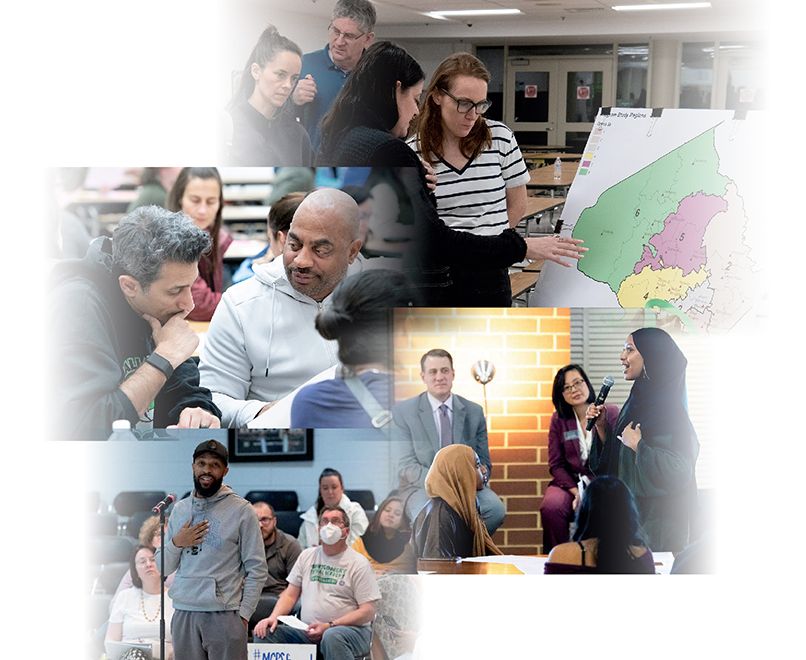
Throughout the 2024–2025 school year, the central leadership strategy for Montgomery County Public Schools was the superintendent’s commitment to active, visible community engagement.
The superintendent launched a listening tour across the county, holding sessions at high schools, community centers, and neighborhood hubs. These forums were publicly advertised in multiple languages, with translation services provided (including Spanish and American Sign Language at events like Paint Branch High School on October 21 and Walt Whitman High School on November 14).
Critically important, the superintendent was not just there to deliver messages—he asked direct questions: “What’s working? What needs attention?” and “How can we do better in academics?”. This posture of humility and curiosity fostered trust and signaled that community voice would steer the district’s decision making.
The superintendent was also deeply involved in budget engagement throughout the fall and winter. The administration held several operating budget hearings, inviting parents, students, staff, and community members to testify, ask questions, and offer feedback on resource allocations. These forums were livestreamed and broadcast, enhancing accessibility.
Whether presenting a funding proposal at a press conference or listening at a hearing, the superintendent’s presence—responding and clarifying—reinforced that equity and transparency are nonnegotiable values in MCPS’s fiscal planning.
Over the year, this approach extended to engaging the broad stakeholder ecosystem: Board of Education members, principals, teachers’ unions, central office staff, students, parent leaders (PTA), nonprofit advocacy groups, faith-based organizations, county elected officials, business partners, and higher education institutions. In every interaction, the administration aimed to position these groups not as separate camps, but as collaborators in shaping schooling that truly reflects community values and needs.
The district continues to strengthen collaboration with community partners to expand access, equity, and engagement for our families. Partnerships with the MCPS Education Foundation, County Government, Montgomery College, and numerous nonprofit and faithbased organizations have broadened the district’s reach, ensuring families receive comprehensive academic, social, and wellness support. This collective effort reflects the belief that meaningful engagement requires shared responsibility—with partners working side by side with schools and families to help every student thrive.

The Capital Improvements Program (CIP) is MCPS’s multi-year plan for managing and financing facilities, which includes building new schools, modernizing existing structures, and addressing capacity needs.
The FY2025 Educational Facilities Master Plan provided critical funding to support this continuous, significant investment, ensuring schools remained safe, modern, and able to accommodate our growing student enrollment, ultimately creating an effective learning environment for all students.
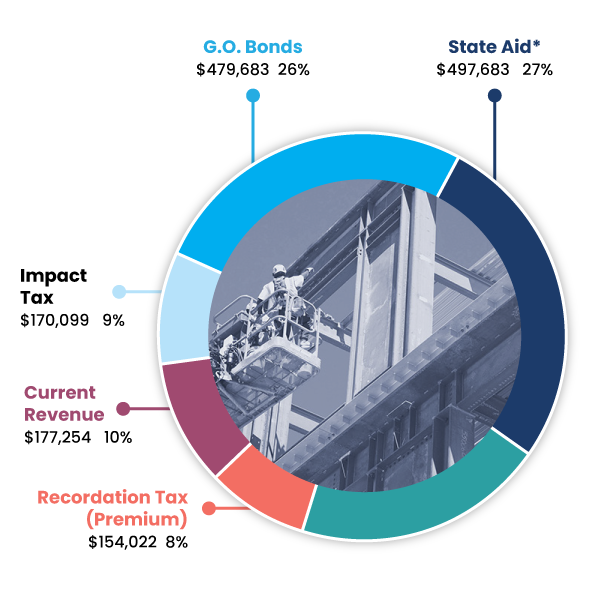
*this state aid total reflects the assumed amount for the Charles W. Woodward HS project.
Our Capital Improvements Program (CIP) is moving aggressively to modernize our infrastructure, ensuring safe, modern learning environments and addressing capacity needs across the county.
These projects represent significant investments in new facilities, replacements, and major modernization efforts:
| Objective | Performance Metric(s) | Measures | 2024-2025 Baseline |
2025-2026 | 2026-2027 | 2027-2028 | 2028-2029 | 2029-2030 | Reporting Frequency |
|||||
|---|---|---|---|---|---|---|---|---|---|---|---|---|---|---|
| Target | Actual | Target | Actual | Target | Actual | Target | Actual | Target | Actual | |||||
| OBJECTIVE 1 — Provide competitive compensation, highquality and affordable benefits, and wellness support to all staff. [BP: Pillar 2] | Benchmark comparison of average teacher/employee salaries and benefits against neighboring or similar districts | Annual Salary Churn Rate Exit Surveys |
MCPS Compensation: 10-month Annual Teacher Salary: $100,010 12-month Annual Teacher Salary: $128,899 Maryland Average Teacher Salary: $87,409 |
Annual | ||||||||||
| OBJECTIVE 2 — Establish and maintain staffing standards and program capacity standards that meet the needs of students and effective operations. | % of classrooms/programs meeting studentto-staff ratio standards based on district benchmarks | Student-Teacher Ratio | In Development | Annual | ||||||||||
| % of positions filled by the first day of school and average time to fill vacancies | Positions Filled | 97.5% (as of 8/26/25) Average time to fill in development |
Annual | |||||||||||
| % of schools/programs operating under capacity constraints | Capacity Enrollment Capacity CIP Chart |
Overutilized ES: 28/137 = 20% Overutilized MS: 3/40 = 8% Overutilized HS: 11/25 = 44% TOTAL: 42/202 = 21% |
Annual | |||||||||||
| % of schools/programs operating with staff shortages by type | Staffing Shortages/Vacancies | 95.4% for special education teachers 92.5% for special education paraeducators 97.8% EML teachers (as of 8/26/25) |
Annual | |||||||||||
| OBJECTIVE 3 — Ensure that all students have access to high-quality, highly qualified, diverse educators. [BP: Pillar 2] | % of teachers who are certified and teaching within their subject area/expertise | Certification in subject area | 96% | Annual | ||||||||||
| % of National Board Certified Teachers in schools with 3 stars or lower | NBCT Teachers | 50.9% | Annual | |||||||||||
| % of educator workforce identifying as Black, Hispanic/Latino, Asian, or male | Educator Diversity | All Staff: 19.6% Black 18.5% Hispanic 10% Asian 26.7% Male Teachers: 13% Black 10% Hispanic 7% Asian 21% Male |
Annual | |||||||||||
| OBJECTIVE 4 — Create pathways, career ladders, and professional learning opportunities for all staff, aligned to individual employee and district goals. [BP: Pillar 2] | % of classified and certified staff promoted internally through career-ladder programs | Career-ladder program completion | In Development | Annual | ||||||||||
| Number of staff participating in leadership pipeline, certification support, or advancement programs, disaggregated by race/ethnicity | Leadership pipeline program participation | In Development | Annual | |||||||||||
| Year-over-year increase in diversity of principal applicant pools | Principal application diversity | 64% of the 44 principals hired were diverse | Annual | |||||||||||
| OBJECTIVE 5 — Ensure all staff engage in inclusive, culturallyresponsive, and antiracist practices. | % of educators participating in inclusive, culturally responsive, and antiracist professional learning opportunities | Professional learning opportunities | 44.7% | Monthly | ||||||||||
| % of educators with practices indicated as culturally responsive based on rubric | Implementation based on rubric | In Development | Annual | |||||||||||
White: 66.6%
Black or African American: 14.4%
Hispanic/Latino: 9.9%
Asian: 7.3%
American Indian or Alaskan Native: ≤5%
Two or More Races: ≤5%
Native Hawaiian/Pacific Islander: ≤5%
Every year, MCPS celebrates educators and staff who go above and beyond for our students, embodying our commitment to educational excellence and student success.
On May 6, 2025, the Montgomery County Board of Education and MCPS presented the 2025 Distinguished Service to Education Honors. During a special ceremony, the district recognized 20 exceptional individuals. Nine received awards for the profound and lasting impact they have made on our school communities.
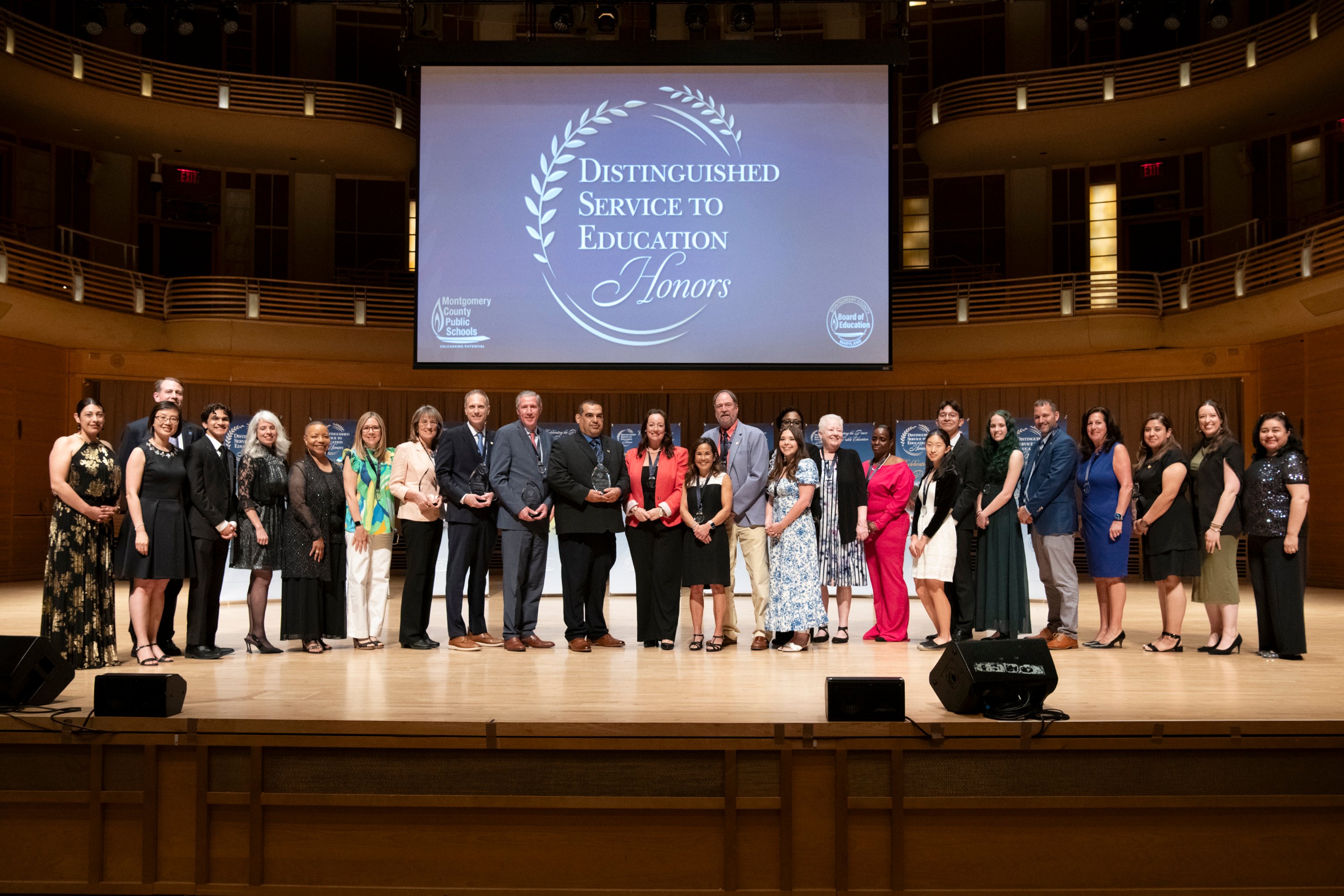
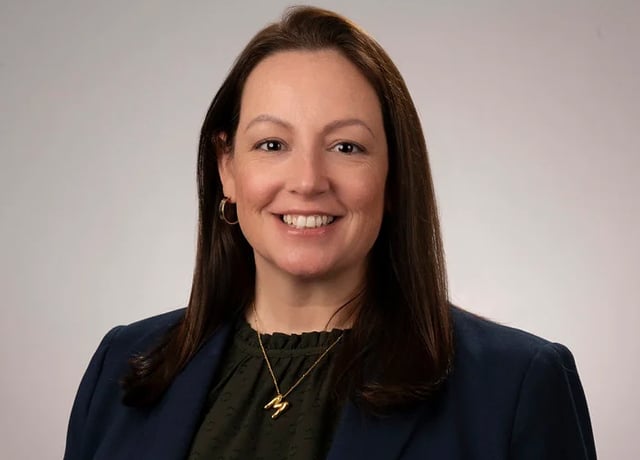
Megan Campbell, an instrumental music teacher at Parkland Middle School, was named the 2024-2025 MCPS Teacher of the Year.

John Sparrow, a paraeducator at Poolesville High School, was recognized for his essential support role.
We celebrated the crucial roles of our counseling professionals, honoring three counselors for 2024–2025:
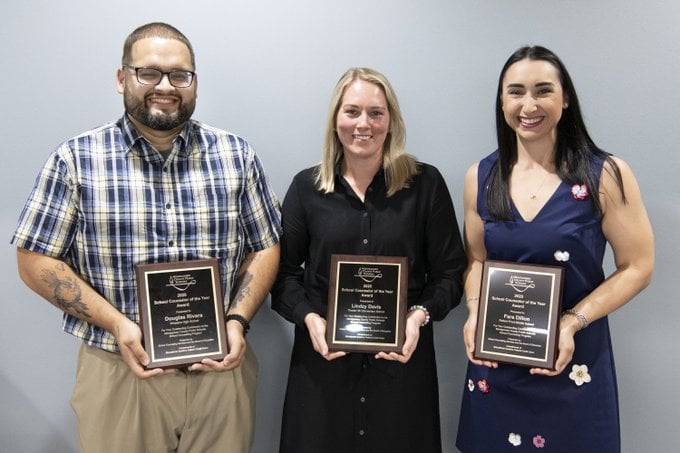
Douglas Rivera
Wheaton High School
Fara Dillon
Robert Frost Middle School
Lindzy Davis
Flower Hill Elementary School
Honors were given to:

Dr. Joshua Fine
Principal
Flower Hill Elementary School

Rebecca Burtram
English teacher
Odessa Shannon Middle School
We also recognized outstanding finalists across these categories: R.A.I.S.E Champion of the Year, Student Service Awards, and Business, Community, and School Service Volunteers. Each honoree represents the caliber of dedication that drives student success across MCPS.
Learn more about all the winners and finalists by visiting the awards webpage here.
The district actively supports teachers pursuing the prestigious National Board Certification, a rigorous, advanced credential recognizing accomplished teaching.
As of the 2024–2025 academic year, MCPS is proud to employ a total of 964 National Board Certified teachers across the district.
The following data represents the distinct growth and engagement activities that contributed to this high number throughout the 2024–2025 school year:
We offer targeted development opportunities to help our support professionals—from bus drivers to office staff and paraeducators—grow their skills and advance their careers.
This year, principal training focused on improving coaching and feedback for teachers, specifically in math and literacy instruction for students learning English and those with disabilities.
Over 900 district leaders participated in professional development focused on antiracist and culturally responsive leadership. This investment in our staff directly translates to better support for all students, particularly those from marginalized communities.
In the summer of 2024, 3,000 teachers attended 58 professional learning sessions (two-thirds of which were required), across 14 content areas. The focus was on ensuring teachers were ready for the school year and equipped with the latest skills.
Teachers highly rated the training:
Key training covered important priorities like new curricula (Middle School Language Arts, Grade 4 Health), strengthening our literacy support system for students, and integrating teaching strategies for English Language Learners in high school social studies classes.
Strong Start for New Educators
We welcomed 596 new educators to the district this year. MCPS’s New Educator Orientation (NEO) provides a strong foundation in curriculum, assessment, and effective classroom strategies for our diverse student population, including those with special needs or who are learning English.
NEO helped teachers feel connected and prepared:
MCPS also released a new resource guide for school leaders to support new teacher development on key topics like classroom management and culturally responsive teaching.
MCPS delivers a robust, standardsaligned instructional program focused on equity and excellence.
This year, principal training focused on improving coaching and feedback for teachers, specifically in math and literacy instruction for students learning English and those with disabilities.
MCPS is advancing innovative teaching by blending technology, online learning, and hands-on experiences to deepen and accelerate student learning.
The 2024–2025 school year was designated the Year of the Coach, serving as a year-long tribute to the coaching profession and the outstanding leaders within MCPS. The initiative launched with a Fall Coaches Appreciation Week (September 30–October 5) that culminated in National Coaches Day (October 6), with systemwide and school-based celebrations held throughout the year.
The School-Based Food Assistance Grant Program is dedicated to ensuring students and families have reliable access to healthy food where they are every day: in our schools. The program provides funding to community partners to develop and expand innovative food assistance projects operating directly out of MCPS school sites.
In FY2025, the grant program invested $1,250,274 across 11 community organizations. This critical funding supported the creation and expansion of food assistance programs at over 60 Montgomery County Public Schools site. Each awarded organization partnered directly with MCPS to deliver essential food resources, working hand in hand with school staff to meet the identified needs of their local school communities.
TOTAL: $1,250,274
MCPS is positioned for continued success. Our students are achieving at high levels, our staff is dedicated and well-supported, and our community partnerships are strong. The investments we're making—in teacher compensation, mental health supports, antiracist practices, and educational innovation—position us to continue preparing students for success in college, careers, and life.
We're grateful for the support of our families, community partners, and the resources committed by Montgomery County. Together, we're building a school system where all students can thrive.
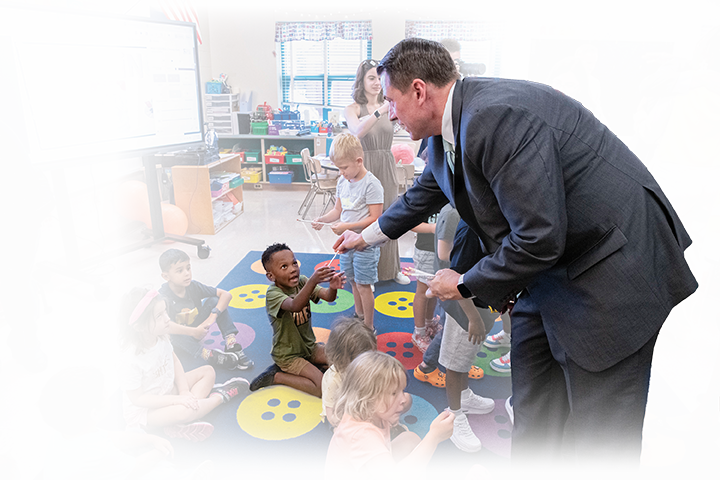
During the 2024–2025 school year, the Montgomery County Board of Education continued to provide direction and oversight for Montgomery County Public Schools by setting goals, establishing policy, and allocating resources to support student success. Guided by its mission, vision, core purpose, and core values, the Board led with a focus on continuous improvement and accountability. Through regular business meetings, public sessions, committee work, and outreach with community partners, the Board maintained strong governance and ensured transparency in decision-making.
Throughout the year, the Board advanced key priorities critical to student learning and well-being. These included monitoring progress in reading and math, especially at transition grades; strengthening school safety and student belonging; supporting innovative strategies to recruit and retain a talented workforce; and reviewing curriculum and graduation requirements to ensure relevance and engagement. By listening to community perspectives, engaging stakeholders, and collaborating closely with the superintendent and staff, the Board continued to champion a school system where every student is prepared to thrive.
To learn more about Board of Education members, committees, policies, and ongoing work, please visit the Board of Education website.
Julie Yang
President / District 3

Grace Rivera-Oven
Vice President / District 1

Karla Silvestre
At Large

Rita Montoya
At Large

Brenda Wolff
District 5

Laura Stewart
District 4

Natalie Zimmerman
District 2

Praneel Suvarna
Student Member
Thomas W. Taylor, Ed.D., M.B.A.
Secretary/Treasurer
Superintendent of Schools
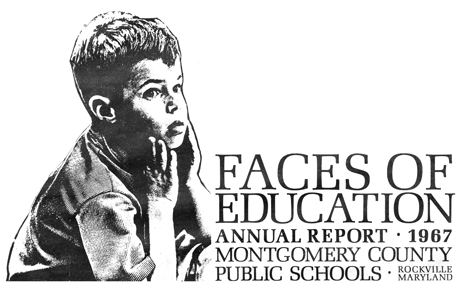 The first MCPS logo was designed in 1966 by Robert Bourdeaux, a member of the school system’s fledgling graphics department team. He used pen and ink to create the original look. It made its official debut in the 1967 Annual Report, titled Faces of Education. The design has been reimagined a few times since, as depicted below.
The new logo celebrates the journey from a distinguished past to a bold and promising future, guided by the timeless lamp of knowledge. Notably, MCPS Art Director Thomas Bourdeaux (the nephew of Robert Bourdeaux) led the design of the latest iteration of the logo, focusing on the initial concept of the lamp of knowledge, inspiring a lifelong love of learning in every student.

This genie-style oil lamp has been used since antiquity—by Greeks, Romans, and in Indian and Buddhist traditions. The lamp evokes ancient wisdom and the magical power of learning.
Visit the MCPS website to see more versions of our logo.