KPPTA Science Fair - March 24, 2026
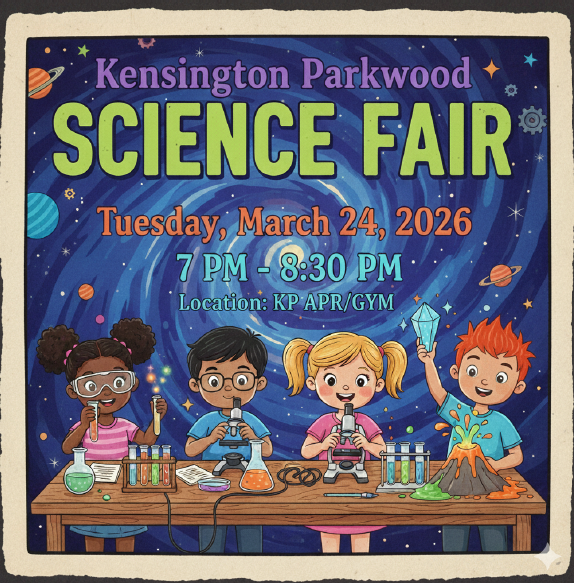
Kensington Parkwood Science Fair Guidelines
Tuesday, March 24, 2026 | 7:00 PM - 8:30 PM in All-Purpose Room (APR)/Gym
1. The Science Fair is noncompetitive. The purpose is for students to experiment with science and to have fun showing others what they have learned.
2. A variety of projects are acceptable. Participants may conduct an experiment, describe how it was done and what was concluded; demonstrate a physical principle; or report on an observation or scientific collection.
3. Students in Grades K through 5 may do a project by themselves or with schoolmates.
4. All participating students must submit a participation form. To participate, the Google form must be completed at least 1 day before the science fair (by 7:00 PM on March 23, 2026).
Participation Form: https://forms.gle/tZ9BHPiR8BCSkDkx5
5. STUDENTS MUST PROVIDE THEIR OWN DISPLAY BOARDS. If you are unable to provide a display board due to special circumstances, a limited number are available. Please email Rachel Margolis (rach.margolis@gmail.com) at least one week before the science fair. All projects will be on display in APR/Gym. Self-supporting, tri-fold display boards or similar self-supporting boards designed specifically for Science Fairs are encouraged. Projects must be situated to adequately contain spills or liquid.
6. SLIME - Participants may describe “Slime experiments” but cannot make slime or create a mess with slime during science fair. Slime demos must be self-contained in bags or plastic containers.
7. All boards must have names of participants clearly written on the front along with names, grade, and teacher on the back.
8. All projects are to be brought to the All-Purpose Room at the beginning of the Science Fair on the evening of March 24, 2026 (set up is from 6:45 PM – 7:00 PM).
9. The Science Fair will take place from 7:00 PM – 8:30 PM for families and friends. Participants are expected to be with their display boards to present and discuss their project from 7:00 PM – 7:30 PM and then can walk around the rest of the science fair to visit the other exhibits. Students will be asked to dismantle and take their displays home at the conclusion of the fair. PARENTS/CAREGIVERS: AN ADULT MUST ACCOMPANY ALL CHILDREN TO THE SCIENCE FAIR. All participants and guests agree to standards of proper school conduct and will confine their activities to the designated areas.
10. Participants may not hand out candy in association with their project presentations.
11. Presentations must meet safety standards and adequately contain spills of liquids. The use of hazardous chemicals and equipment, poisons, live animals, electricity (in the form of AC current), matches, fires, Bunsen burners, propane gas, and hot plates is prohibited. Projects deemed dangerous or inappropriate will not be admitted.
---------------------------------------------------------------------------------
HOW TO PREPARE A SCIENCE FAIR DISPLAY BOARD
At meetings and conferences, scientists present information from their experiments on a display board. They stand by the boards, present the data from their experiments and explain to other scientists what they have done and what they learned. As a student presenting a project at the Kensington Parkwood Science Fair, you will be doing the same thing. The only difference is that you will be explaining your project to other students, friends, and family members.
Use the following guidelines to tell the story of your science experiment on your display board. FRONT
1. A TITLE - this will alert attendees to what you have done (and catch their attention!)
2. NAME(S) OF STUDENT(S)
3. TELL THE STORY OF YOUR EXPERIMENT - Answer these basic questions:
a. STATE THE PURPOSE OF YOUR PROJECT/EXPERIMENT - What did you want to find out?
b. STATE YOUR HYPOTHESIS - What did you think would happen?
c. LIST THE MATERIALS YOU USED IN YOUR EXPERIMENT - What items did you use?
d. DETAIL THE METHOD/PROCEDURES YOU FOLLOWED - How did you get your answers?
e. STATE THE RESULTS - What happened? (You may have been proven wrong, and that’s OK!)
f. MAKE CONCLUSIONS ABOUT THE RESULTS - What did you learn?
You may have photographs, charts, graphs, or other visual aids that you will want to attach to your display board to help you tell what you learned. Your reports and explanations can be typed or handwritten. Try to make it exciting!
Depending upon what you did, you may want to demonstrate your project. Remember that all presentations must meet safety standards and adequately contain spills of liquids (see guideline 11 above).
BACK
1. Name(s) of student(s), grade(s), and teacher(s).